
Inevitable Differences
An Inquiry into Human Variation

(Academica Press, January 31, 2026)
by
J. E. R. Staddon
This book began with my puzzlement about a number of influential writings, mostly by black authors, about different kinds of racial disparity. Why was the work by Ibram X. Kendi, Robin DiAngelo, Ta-Nehisi Coates, Richard Delgado, Eduardo Bonilla-Silva, William Darity and others, based as it is largely on faulty logic and empirical fallacies, so influential? Why was criticism so muted?
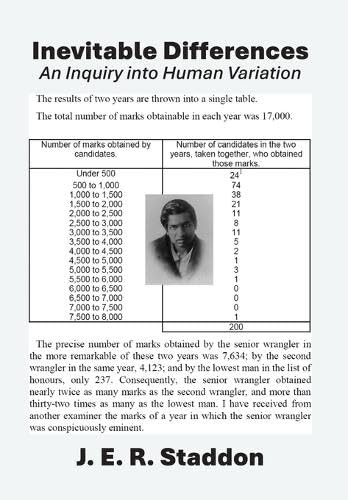
One obvious reason is that contemporary white academics are unwilling to criticize black authors, a practice that benefits neither authors nor critics. But further inquiry revealed a more fundamental problem. One party, headed by Kendi, started from the obviously wrong premise that everyone is the same, and not just morally or in terms of legal rights. Kendi claims that all have the same repertoire of talents, which is a denial of human variation and basic biology. But, conveniently, if this premise is true, existing inequalities must reflect widespread racial discrimination — racism. Obviously, racism is bad and must be eliminated, which usually requires some form of compensation. This is Kendi’s antiracism. All must be made equal, probably by state action.
But another party, headed by social-justice advocates such as political philosopher Michael Sandel and behavioral geneticists such as Kathryn Paige Harden, are happy to accept the reality of individual and group differences in cognition and behavior. Nevertheless, they were able to come to the same conclusion as Kendi. Although differential outcomes may be a result of differential natural talents, social justice requires compensatory changes: all must be made equal.
Social differentials may often be ‘just deserts,’ bad behavior leading to poverty, good behavior to social success, and so on. Nevertheless, the social-justice faction still insists on equal outcomes. For Harden and Sandel, essentially every human attribute is an accident of birth, the outcome of a lottery, and the idea of ‘just deserts’ is fundamentally unjust.
In other words, both groups, arguing from different premises, came to the same conclusion. In Kendi’s case the premise, the essential identity of all people, is wrong. In Sandel’s case the premise of human variety is correct. The “all should be equal” equalitarian conclusion is derived from another premise, based on the “last shall be first” ethics of moral philosopher John Rawls.
This book digs deeper into these issues, looking carefully at influential writings by popular authors and trying to disentangle the sometimes incoherent philosophy that underlies them. I conclude that human variation is real. It is not to be denied or eradicated. Instead the variety of human talent should welcomed and exploited.
CONTENTS
Introduction 1
Chapter 1: Science, Facts and Values 11
Chapter 2: What is Social Justice? 17
Chapter 3: Systemic Racism: Red Flag — or Red Herring? 29
Chapter 4: REPARATIONS: Cui Bono? 43
Chapter 5: ANTIRACISM: Kendi’s Fallacies and DiAngelo’s Trick 55
Chapter 6: The Corruption of Social Science 71
Chapter 7: Race and Ethnic Studies: Color-blind Racism 79
Chapter 8: Statistics, Eugenics and Sinister Motives 89
Chapter 9: What is Critical Race Theory? 101
Chapter 10: Faux Economics and REPARATIONS as Rent Seeking 117
Chapter 11: Unconscious racism: the ‘science’ 133
Chapter 12: Education, Inequality and the Ideal Society 139
Appendix: Heritability and IQ 151
Acknowledgements 157
I think the point that the two groups start from different assumptions and converge on the same prescription is very interesting.